Backup That Rappel or Else!

Picture this: It’s the end of a long day of cragging. You’ve been pushing it hard all day, and with the light fading you’re anxious to get back to the car and some ice cold PBR’s. You rig the last rappel, a full 30m off the ground, and cast off. Soon after leaving the anchor somewhere above you a bowling ball sized rock comes crashing down into your chest.  Stunned by the pain, you take your brake hand off the rope for a split second, but soon you’re plummeting towards the ground before you even know what  is happening. Hopefully you’ll land in a bush or something and survive the ordeal, but maybe not. Too bad, cause this was an easily preventable outcome if you’d just backed up your rappel.

Yesterday I came across this interesting article about using an autoblock for a rappel backup, and thought it was worth sharing. The basic premise of the post is that not using a backup while rappelling is tantamount to free soloing. I’ve never really thought about it like this, but it does make sense. In free soloing, the only thing keeping you off the deck is how well you can hold on to the rock. In rappelling, the only thing keeping you from certain doom is your hands on the rope. Now I’ll admit, for years I didn’t give much thought to backing up a rappel, unless I was in an alpine setting where one falling rock or chunk of ice could spell doom. Then I started hanging out with this cute blonde chick, who I soon nick-named Captain Saftey because of her commitment to being as safe as possible while climbing (which might have had something to do with the two ground falls she had witnessed, one of which resulted in a fatality, and both of which were easily preventable.) One thing lead to another and soon I was maried to this incredible woman, who helped instill in me a better sense of being smart while out climbing. As a result, over the last couple of years I’ve made it a habit to use a prussik (or at least get a fireman’s belay if possible) whenever I have to rappel.

The author also points out that a quick perusal of Accidents in North American Mountaineering shows a high number of incidents that occured while folks are rappelling, so why not stack the odds in your favor? Now a lot of people probably think it’s just not worth the hassle, nothing has ever happened to them, what’s the big deal? But the point is all it takes is one mistake while rappelling and it’s lights out. Here’s an easy way my friend Mike showed me to keep a small cord on my harness for use as a prussik. It’s low key and stays out of the way, but when you go to rappel you just unravel it and you’re good to go. Plus you’ve always got a prussik on you which can be handy for self rescue situations.
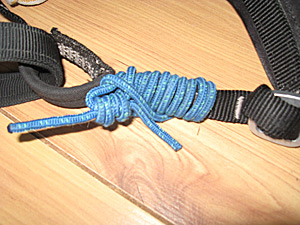
prussik

Bottom line, I agree with what the author is saying, and I think if more people thought of rappelling without a backup as free soloing, they’d probably think twice about not backing up the system. Be safe out there.


8 Responses to “Backup That Rappel or Else!”

  1. Yuani says:

    Nice post, I honestly don’t see a lot of people adding a backup to their rappel rig. The AMGA has been teaching this for years. I took a class in the mid-nineties that first taught me about extending my belay device off the loop (for better control) and employing a backup. I’m sure captain safety would also approve.

  2. Kate C says:

    I like this write-up a lot, thanks! It does seem like most accidents in climbing revolve around rapping. It’s a non-redundant system that we take entirely for granted. I carry a biner on the back of my harness with a knife, cord for a prussik and a tibloc. It’s a very light-weight self-rescue rig that could be the difference between a helicopter rescue off the top of Sundance buttress or getting home safe and happy. But I had a random guy, whom I had never met, pass us on the bookmark last summer and go off on my safety biner! “Why are you carrying all of this stuff? Do you really think you’re going to have to do a self rescue? What, are you going to cut the rope and save yourself??” He thought he was hi-larious. Jack-tard.

  3. Lou says:

    Good backup is just have someone hold the end of the ropes, if you go out of control because of a bee sting, they just pull and the tension they make slows you down or stops you. Basic guide’s technique…

  4. BJ Sbarra says:

    I agree Lou, that’s usually the simplest solution, though it wont work for the first person down.

    @Kate C Crazy that he was so irked by what you were carrying. Some people!

  5. Mike says:

    Great advice. Rappelling is one of those things that you can do a million times and never have a problem with but it takes just one mistake to have a bad accident. There are too many examples of knowledgeable and qualified climbers losing their lives or getting hurt from a freak mistake. I have used the method BJ describes here since I took my first AMGA course. It’s small, lightweight and stays out of the way and it’s super easy to pull it out in a jiffy when you’re cleaning a pitch, swinging into an overhanging rappel station or whatever potentially sketchy manuever you might be involved in. My wife likes to use hers when rapping on skinny cords because it can provide a little extra security.

  6. Craig says:

    Cool. If you don’t have a prusik, you can use a sling. The old GRB (guides rappel backup). Tie it around the rope below your rap device with a prusik knot and clip or tie it the leg loop on your harness. You do have to hold onto the prusik while rapping or it will bind up in the rap device, which is bad!

  7. rgold says:

    The set-up pictured in the referenced account is potentially dangerous; the back-up knot is too close to the rappel device. For more info, see http://www.rockclimbing.com/cgi-bin/forum/gforum.cgi?post=2080626#2080626.

    It is worth at least mentioning that there are other ways of making rappelling more secure that don’t have the drawbacks of a backup knot (such as rigging it so that it may not work). The fireman’s belay from below is a better alternative, so the only person who needs some other type of backup is the first person down. But the first person down can easily rap on a single strand while being belayed with the other strand. The main drawback of this is that it isn’t macho enough for most folks.

  8. Mike says:

    The method described on rc.com is not quite the same as the one described here. When the method described here is used properly the concern mentioned on rc.com won’t happen. As with anything, if you don’t rig it properly, it has the potential for failure. Hence, to try to write off this method of backing up a rappel because of the reasoning provided is pretty ridiculous. The method BJ describes here entail leaving the prusik girth hitched into the leg loop of the harness, thereby significantly shortening the length of the prusik so if you apply the proper number of wraps, with an appropriate length of prusik, then it won’t interfere or obstruct the rappel device. If you’re worried about it, then you can extend the rappel device with a sling. A fireman’s belay, while good to know, is not a feasible option for every rappel backup. Part of the idea behind the backup described by BJ is that it gives you a readily accessible rappel backup that takes a few seconds to apply because how many times have you seen people say, “I should probably back this up but I don’t feel like getting out a sling.” It is a method thoroughly espoused by the AMGA and if you take an AMGA course, chances are you’ll add one to your harness too after seeing its usefulness.

Leave a Reply