
-
Climbing, Adventure, Gear & Choss


Tech Tip – Rappelling with a GriGri (or Cinch or what have you)
By Mike Schneiter
Multi-pitch sport climbing, though somewhat rare in the US, is such a joy. I love the feeling of casting off on long pitches of beautiful face climbing, with nothing but a dozen quick draws bouncing off my harness. Forget the extra burden of cams, stoppers, cordalettes and related gear. And you can also forget that ancient belay and rappel device commonly referred to as an ATC.
Recently, on a multi-pitch sport outing, I collected the rope for our descent when my partner looked on perplexingly as I prepared for the rappel. “Forget that thing, grab your GriGri, we’re sport climbing.” Realizing he wasn’t familiar with how I was going to descend, here’s a little tech tip on how you can embrace your inner sport climbing mojo and apply your sport belaying and rappelling techniques to a wide variety of descents.
How To (click to enlarge photos)
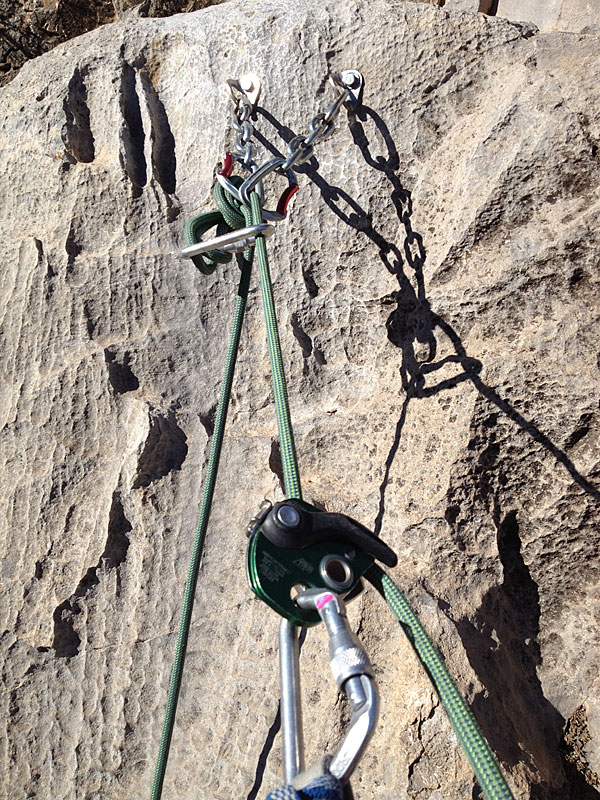 Run your rope through the anchor like you normally would. On the strand you aren’t going to rappel on, tie a Big F’ing Knot (BFK, it’s a technical term of course) such as a Figure 8, Yosemite 8, or Figure 9. The whole point here is you want a big knot that won’t pull through the rings or chain or whatever the rope is going through at the anchor. Clip the loop from the BFK into the side of the rope you are rappelling on with a locking carabiner.
If you are rappelling on a single rope make sure both ends are touching the ground. You will pull the side of the rope that has the big knot in it. You will rappel on the other side. Good practice is always to fully weight your system after clipping your belay device into the rope and before unclipping yourself from the anchor. In this scenario, it is a good check that you are rappelling from the correct side of the rope and you have a good knot against the anchor that won’t pull through.
If you are rappelling a full rope length and are using a tag line to pull the rope do all of the above plus the following: Clip your tag line into the 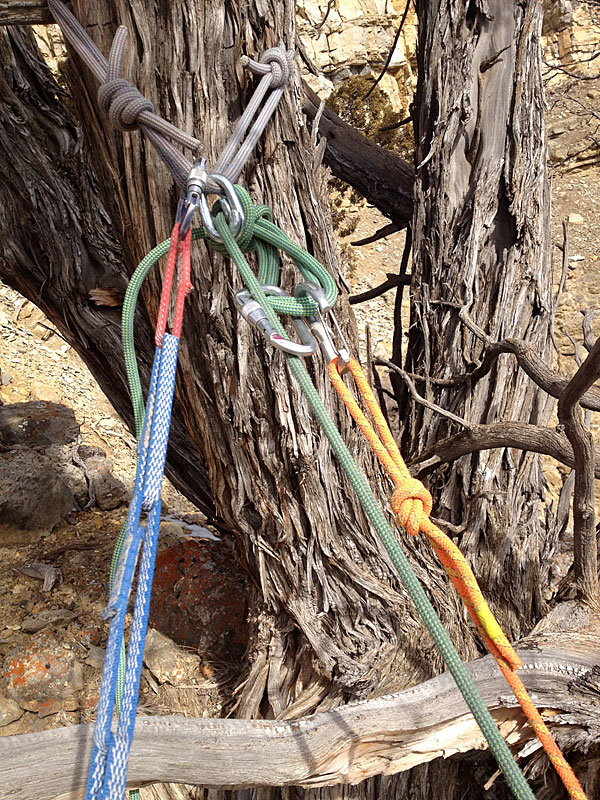 same loop you’ve clipped into your rope. You can just tie a simple overhand into your tag line and clip it into the loop with a carabiner. After you rappel you will pull your tag line to retrieve your rope.
When It Works
– You’re climbing multi-pitch with a GriGri, Cinch or similar device that only handles single ropes. It has become increasingly popular to climb multi-pitch routes with devices that have traditionally been reserved for sport climbing duty. I’ve talked to prominent guides who even advocate carrying multiple devices, such as the GriGri, for multiple clients because it makes many tasks easier, such as lowering, raising and a whole host of tricks. These devices have been getting lighter and hence, it makes more and more sense to use devices such as these for their ease of use.
– You want the ability to easily go hands free while rappelling in order to perform tasks such as freeing a stuck rope, cleaning a route, or because you need to swing into an anchor on an overhang. Maybe your climbing partner just tossed a mess of rope off the ledge with the same care a high schooler gives to their job in a fast food joint. You look below and see a snarl of rope stuck in cracks, wrapped around small trees and being pierced by cacti. Rather than back up your rappel you can cast off without worry, rappelling on your GriGri or device of choice.
– You’re climbing at your favorite sport destination and you decide to rappel because you want to do some cleaning on your project and your belayer is anxiously awaiting his chance to chat up that cute girl a few routes down wearing the Prana capris. Carrying an ATC or traditional belay device at a sport crag like Rifle is akin to showing up at an al Qaeda training camp with a yarmulke. Hence, all you’ve got is your beloved idiot proof belay device (read: sport climber belay device).
– You’re at the top of a climb with your brand new, shiny climbing rope looking down at a muddy mess at the base of the climb created by the spring conditions. There’s a ledge a few feet off the ground where you could finish and keep your fancy new cord all pretty and nice. Drop the rope to the point where you want to finish, safely above the muddy mire below and rappel away. Similarly, there are plenty of climbs where your rappel route looks like a scene from a car wreck and the threat of sticking a rope in a nasty crack or on some choss-filled ledge is a serious concern.
– When I am rope soloing, such as on TR laps, this tends to be my rappel method of choice. I’m usually just doing one or two pitch climbs and the pulls are usually easy. I like to keep things as simple as possible and I usually have enough on my harness already so carrying an ATC for rappelling is just something extra that will get in the way.
When It’s Not a Great Idea
– This rappel method works great for steep, sport pitches and rappel routes that are free of snags, but if there is a feature that could potentially snag your BFK then you’ll want to avoid this setup. Cracks, horns, and other protrusions that can interfere and stick a rope are what you want to watch out for, as you would on any rappel.
– Similarly, if the rappel anchor is situated so that you’re going to have to pull the rope over an edge or other obstacles it may make the rope difficult to pull. Savvy rope pullers may not be deterred by this, but others may take pause and choose a traditional rappel.
– You might think twice if there is something funky about your rappel anchor. I’ll leave that up to you to decide what that is. If you climb long enough you’re probably going to rappel off something weird and while this method doesn’t exert any extra force onto an anchor there is always the possibility that you’re rappelling off something different enough that maybe you don’t want to do this. So, this is basically my disclaimer to say, “I have no responsibility for your own safety, use your best judgment, if you set this up wrong you could get hurt or die!”
Mike Schneiter doesn’t only climb multi-pitch sport routes, but he loves how light your pack is when you do. He is the owner of Glenwood Climbing Guides.




Bulldog Creek Dog Walk (IV WI 4+)
Hayden Carpenter and Tom Bohanon recently repeated an obscure ice climb on the south side of Mt Sopris. Given a brief mention in Jack Robert’s ice guide, Bulldog Creek Walk is described as being 100 meters of WI 4. What they found was seven pitches of ice in a remote setting that makes for one […]
Connect with Us


5 Responses to Tech Tip – Rappelling with a GriGri (or Cinch or what have you)