
-
Climbing, Adventure, Gear & Choss


The Dangers of Daisy Chains
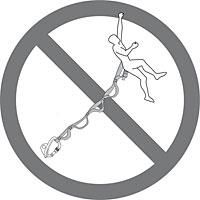 Black Diamond put out an excellent post yesterday regarding the dangers of using daisy chains for anything other than aid climbing. The author, BD’s quality control guru, stated how he constantly sees people using them for both cleaning anchors and anchoring in on multipitch routes, which are functions they are not designed for. Most folks, however, assume they are strong enough for these tasks, and so they use them to make life a little easier. The report goes into detail why both of these situations should be avoided, and I think it’s worth looking at in depth.
The problem, according to KP, is that when you are attached to an anchor with a daisy, you’ve taken the rope out of the system, and made it completely static. This can set you up for a potentially dangerous shock loading situation, in which the daisy can blow apart and/or you can get severely injured due to the high forces of a static load.
A further problem is noted in that it’s quite easy when shortening your daisy to clip it incorrectly, such that in a shock loaded fall it can blow apart and leave you detached from anything. The video does a great job illustrating this.
QC Lab: Daisy chain dangers from Black Diamond Equipment on Vimeo.
Some would be quick to point out (and rightly so) that the Metolius PAS eliminates this scenario and therefore is the safer option, but it doesn’t change the fact that you are still anchored via a static system. Imagine the following:
Many people I know use a daisy chain or PAS to anchor in on multipitch climbs. Typically they will go in short with the daisy and then back that up with the rope. If this is how you are anchored, and your partner is climbing the next pitch and takes a big fall, you will be violently jerked upwards. The daisy/PAS is static, and you’ll take the full brunt of the fall to your back. Ouch, gonna need to see the chiropractor after that one!
Now, I’ve never liked daisy’s/PAS’s for several reasons, and so I always just use the rope to anchor in at belays, but I’ve often used a sling to go in short, which creates the same problem. It seems the best way to anchor in, to avoid any static loading, is simply using the rope. Some might say this only gives you one point, and you need two to be redundant, but the rope is always just one point when you are using it. And if you really want a backup, you could anchor in short with the rope, and then use a long PAS/sling as a backup. This way, the rope would take the impact of any fall and save you from that chiropractor visit.
For many, this isn’t new news, and it seems this info gets recycled every couple of years, but for good reason. There are still a lot of people out there using these potentially dangerous systems. Of course, you could go your whole life and never have a problem, but climbing is all about calculated risk, so why not stack the odds a little more in your favor?




Bulldog Creek Dog Walk (IV WI 4+)
Hayden Carpenter and Tom Bohanon recently repeated an obscure ice climb on the south side of Mt Sopris. Given a brief mention in Jack Robert’s ice guide, Bulldog Creek Walk is described as being 100 meters of WI 4. What they found was seven pitches of ice in a remote setting that makes for one […]
Connect with Us


12 Responses to The Dangers of Daisy Chains