
-
Climbing, Adventure, Gear & Choss


Patagonia Rover Review (& Giveaway!)
(contest details at bottom)
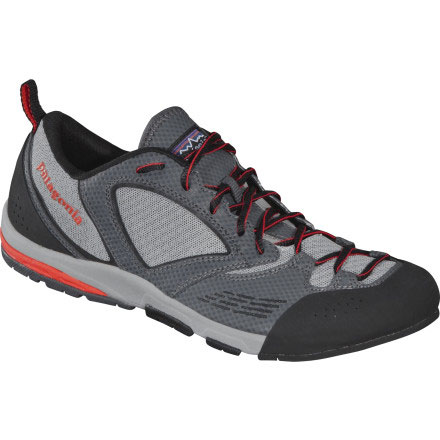 As a guide, and someone who will routinely get 150 to 200 days of outdoor climbing each year, one of the most important pieces of gear I’ll use are my approach shoes. I recently had the chance to try out the new Patagonia Rovers, and they didn’t disappoint. Read on for the low down on this lightweight yet impressively durable approach shoe.
The first thing that jumped out at me was their weight. At 8.8 ounces, they are almost half as light as the iconic Guide Tennies. On multi-pitch routes where I wanted to be able to carry approach shoes with me on my harness, their light weight and low bulk made them an easy choice, from desert towers to free climbing on big walls. Another thing you might notice right away is the softness of the shoe, which is great for things like shoving them in your pack.
They also climbed nicely thanks to the sticky rubber and well defined edges in the toe of the shoe. I used them extensively on 3rd, 4th and easy 5th class terrain and felt comfortable moving on the rock, smearing on slabs and short roping via stances and body belays. The Rover makes use of a two part sole where the toe area is harder and the heel is softer. This helped the shoe excel at both hiking and climbing. Additionally, smoother rubber under the ball helps the shoe climb well, while more featured rubber under the heel gave it enough traction for hiking.
The shoe is designed as a mix of minimalist trail running and mountain performance, resulting in a 4mm heel to toe drop and relatively slight cushion throughout. I’m a longtime, semi-serious runner who is pretty minimalist with running shoes but this shoe didn’t have enough cushion for me on longer hikes. Particularly, sharp rocks along the trail started to make my feet ache. Their lack of rigidity also prevents them from being ideal for aid climbing or standing on small edges.
The fit of my Rovers was perfect for hiking but occasionally on harder fifth class terrain the Rover started to leave something to be desired, largely due to the lack of support in the shoe. I led up to 5.9 limestone sport in them, but had a hard time standing on edges and didn’t feel as secure as other dedicated approach shoes in this terrain. I also used the Rover while climbing Tricks of the Trade in Zion, a 1,900-foot climb. It was a great shoe to clip to your harness or stuff into a day pack, but on the single aid pitch of the route, my feet were aching after standing in aiders.
Back to the good stuff, the breathability of the shoe is one of its greatest assets. While other approach shoes can make your feet hot and sweaty, leaving you ready to rip them off as soon as you can, the Rover breathes well, which improves the overall comfort of the shoe. On the other hand, if using it to hike through snow or in wet environments, the shoe will get you wet, so that’s something to consider.
Lastly, I was impressed with their durability compared with some of the other lightweight approach shoes I’ve sampled. I burned through two pairs of Evolv Cruzers in a summer, but after 6 months of solid use with over 50 days of walking, scrambling, and climbing, the Rovers are holding strong. I honestly expected the shoe to fall apart before writing this review, and almost made it a personal challenge to do so. I failed in that regard, although, after much effort, they are at least starting to look used like a shoe should. The combination of the rubber toe rand and reinforced toe panels has helped the Rover persevere through repeated abuse.
At $125, the Rover isn’t cheap but it’s also in line with a lot of other approach shoes out there. At first I balked at the price, assuming the shoe wouldn’t be worth it and wouldn’t last. But, after extensive use and seeing how well it can perform, I’m sold.
If you’re looking for a lightweight shoe for shorter hikes and that can climb moderate terrain well, while later hanging indiscreetly from your harness, the Rover is worth a look.
Sizing: I am an 11 street shoe and that is the size I wore in these.
Retail is $125, more info and tech specs are available on the Patagonia website.
Mike Schneiter is the owner of Glenwood Climbing Guides.
CONTEST DETAILS: The good folks at Patagonia are so psyched to spread the love about this shoe that they’ve given us a pair to give away. All you have to do to enter is leave a comment about what you would do with these shoes this summer if you won them. Contest only available to US residents. One entry per person. Winners will be chosen by random drawing through the Splitter Choss super computer. Folks affiliated with Splitter Choss aren’t allowed to enter, more fine print, etc, etc, etc. Contest closes 5/23/14
Check out this video for more on the shoe from Patagonia:
Disclaimer: Wait! Before you go handing over your credit card number, ask yourself, do you really need to buy more new stuff? If so, this product is worth a look. In the spirit of full disclosure, it was provided to SplitterChoss.com for the purpose of reviewing. Don’t worry, though, our integrity can’t be bought!



Bulldog Creek Dog Walk (IV WI 4+)
Hayden Carpenter and Tom Bohanon recently repeated an obscure ice climb on the south side of Mt Sopris. Given a brief mention in Jack Robert’s ice guide, Bulldog Creek Walk is described as being 100 meters of WI 4. What they found was seven pitches of ice in a remote setting that makes for one […]
Connect with Us


42 Responses to Patagonia Rover Review (& Giveaway!)