
-
Climbing, Adventure, Gear & Choss


Black Diamond Launches New Climbing Packs
To an outside observer, this would look really strange. There we were, at about 13,000′ on the Southwest Ridge of Mount Sneffels, and Jeff Achey and I were actually putting big rocks into our packs for the remainder of the ascent. We were on a press trip, to try out the new climbing packs from Black Diamond that feature the Active Frame Technology, a new system that allows the hipbelts and shoulder straps to move with you. It does an incredible job of making your load feel lighter than it is, hence we had to add some rocks to what we were already carrying, to see how much these things could take.
Our group had been brought together by Backbone Media, in order to test the new packs in the high peaks of the San Juans. The night before our ascent of Sneffels, Nathan Kuder, who oversaw the creation of these packs at BD, relayed a humorous story about how these new bags carried so well you could forget you were carrying anything at all. He was out testing a prototype, and came across a stream which required some rock hopping to get across. On the last hop across a bigger gap, he came up short and fell into the stream, because his brain didn’t register that he was heavier with the pack on, due to how well the pack was carrying.
Back on Sneffels, we continued up the peak with the added weight in our bags, scrambling over ridges and crossing a few late summer snowfields. I soon found myself breathing heavier and feeling more strain on my legs, and didn’t immediately make the connection that this was due to the heavier bag, because the pack was still carrying like a dream! From there on, I was sold on the new system, and a 15 mile, 5000′ climb of Gladstone Peak the following day sealed it. These packs were the real deal, and everyone is going to want one.
The Technology
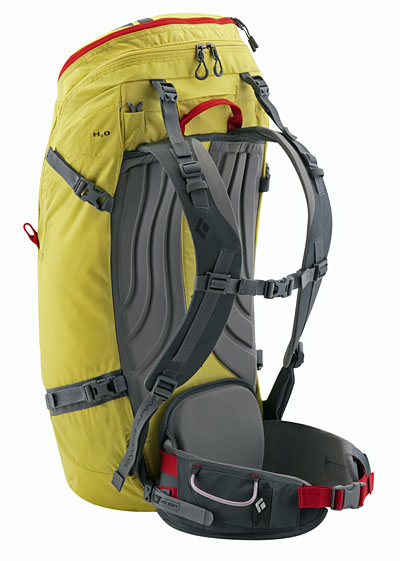
The Active Frame Technology is part of the broader Active Form Design , which combines suspension, fit and construction to create the most high end packs available. It first debuted with Black Diamond’s line of backpacking packs in 2010, and is being applied to climbing specific packs for the first time in 2011 with the launch of the Ascent series. These packs utilize two different suspension systems, the reACTIV and ergoACTIV. Both feature SwingArm shoulder straps that are linked together via a low friction cable on the bottom of the pack, and virtually eliminate hot spots on your shoulders by distributing the weight equally, no matter whether you’re reaching over head for the next hold, or simply walking down the trail.
The reACTIV system is employed on lighter and small packs, with an emphasis on fast and light travel in alpine environments. It’s designed to offer comfort while minimizing bulk for carrying lighter loads over big distances. The hipbelt utilizes a pass through design which allows for movement but is not as bulky as the ergoACTIV system. It also features a lighter frame.
The ergoACTIV system is found on the packs meant to handle heavier loads, and offers an optimal blend of freedom of movement and stability. The centerpiece of this system is the custom shaped ball joint that attaches the hipbelt to the frame. The amount of unrestricted movement that this system offers has to be experienced to be believed. The frames on this system are also a little beefier to handle the heavier loads.
The Packs
The two climbing specific packs that really stood out on our trip were the Axis 33 and the Speed 30.
Axis 33
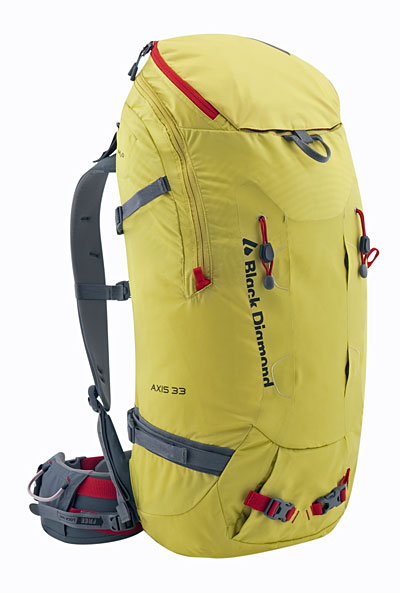
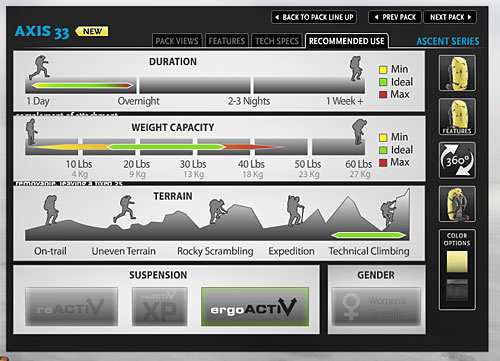
This pack is described by BD as “a fast moving, guide-style climbing pack that moves effortlessly with you in any direction on ice, rock or alpine missions thanks to its patent-pending ergoACTIV suspension and streamlined aesthetics.” This top loading pack has attachment points for a rope, helmet, crampons and ice axes, allowing you to use the main compartment for everything else. And the hipbelt is removable, leaving a fixed 25mm webbing belt for a more streamlined setup. Throw in a thermoformed, vented backpanel and hydration compatibility, and you’ve got a complete package.
I’ve been testing the Axis 33 in the time since our San Juans trip, and I’ve used the pack for alpine, sport and trad cragging. Despite my initial misgivings about a pack this small, it’s really proved itself as a good all-arounder. For alpine and trad cragging, you can get a double set of cams, runners, etc. and the other essentials in there with careful packing. One thing to be wary of is that all these new packs have a recommended weight range. Within that range, they carry as they are intended. Overload it, however, and you’ll get less of the benefits of the suspension system.
Speed 30
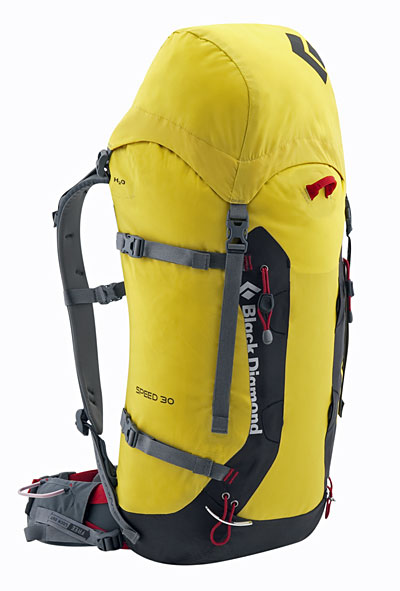
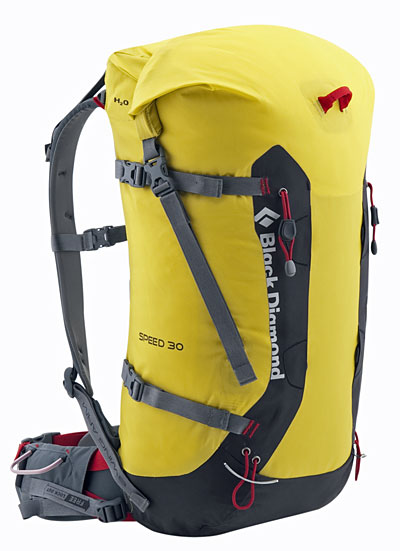
The Speed 30 is a rucksack style pack for fast and light endeavors in the mountains. For the weight conscious consumer, it can be stripped down to the bare minimum by removing the floating top pocket, padded hipbelt, aluminum frame and framesheet. The IceLink attachment system offers a new and innovative way to attach any ice tool to the pack, and you can also strap on a pair of crampons and a rope as well. With the top removed, it closes via a dry bag style, roll-top closure system. It also features a thermoformed, vented backpanel and hydration compatibility.
These packs truly represent a major step up in pack technology, and it’ll be interesting to see how this changes the game. As Nathan pointed out on our trip, while this kind of suspension has been tried before, none have pulled it off successfully…until now. To that end, Black Diamond has an informative new site setup to show off all the new packs coming out that utilize this new technology, www.activeformdesign.com. It’s full of great info, including the recommended use of the pack, weight, distance, etc.
The packs will be on display at the Black Diamond booth (#7015) at the upcoming Outdoor Retailer show in Salt Lake City next week, and should be available in retail shops come Spring 2011.



Bulldog Creek Dog Walk (IV WI 4+)
Hayden Carpenter and Tom Bohanon recently repeated an obscure ice climb on the south side of Mt Sopris. Given a brief mention in Jack Robert’s ice guide, Bulldog Creek Walk is described as being 100 meters of WI 4. What they found was seven pitches of ice in a remote setting that makes for one […]
Connect with Us


7 Responses to Black Diamond Launches New Climbing Packs