
-
Climbing, Adventure, Gear & Choss


Tech Tip: The Big Bad P.A.S.
By Mike Schneiter
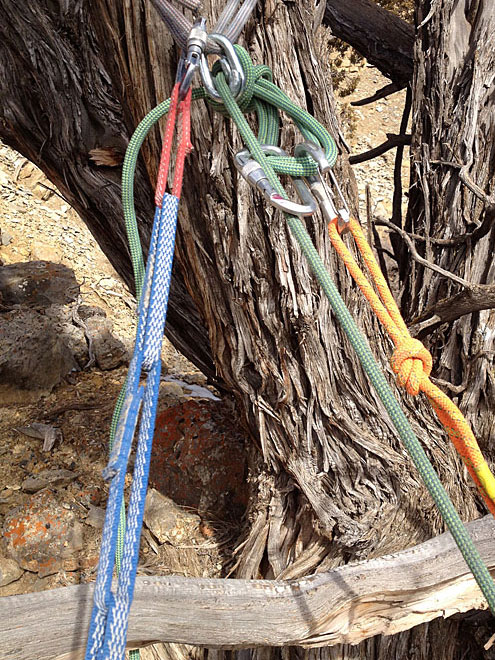 If you’ve spent any time on Internet forums lately, you’ve inevitably run into a post where someone asks a seemingly benign question about the use of a Personal Anchor System (PAS). And, almost without fail, the forum quickly devolves into a scathing dialogue that runs along the lines of “Yer Gonna Die!” for using a PAS followed by a “you should just get rid of that thing, there’s no reason to have one!”
So, is the PAS really some dark, evil creature that should be feared by all?
Personal Anchor Systems have become popular in recent years with many incarnations of the system being made my companies like Metolius, Blue Water, etc. The PAS seems to have arisen out of increased fear, and rightly so, about the use of daisy chains for things other than their intended use in aid climbing (I’m excited, by the way, about the introduction of full strength daisy chains, similar to the construction of PAS’s). Personal Anchor System feature loops of nylon sewn together in a chain but unlike a daisy chain, each loop is independently sewn and hence, is full strength.
Metolius and other companies advertise their benefit for use in a myriad of situations, including cleaning sport routes and equalizing anchors. Any number of suggested uses will still be called heretical on the forums so here’s a brief reason of why or when you might want to use a PAS, thus showing that they don’t have to be the Big Bad Wolf of climbing gear.
Why You Shouldn’t Be Afraid
- Your rope is the best material at hand to anchor yourself into the anchor for a number of reasons on a multi-pitch climb. Still, there are occasions when using a PAS on a multi-pitch climb might be beneficial. Perhaps you decide to bring it along because you’ve got a number of rappels to access the climb or to descend afterwards. Yeah, you could use a sling or slings but maybe it’s a sport multi-pitch where you just want to carry draws. Or, if there are a large number of rappels you might decide on the PAS to have the adjustability and easy storage offered. If you’re climbing in Colorado National Monument, for example, you might be jugging back to the rim after climbing and the PAS can be a handy tool for clipping into ascenders. When guiding I will often bring along my PAS to help free myself up, particularly when I know I may not always be able to stay clove hitched into the same rope at all times. In any multi-pitch scenario your primary contact point should be your rope but the PAS may help things flow in the right situation.
- I use my PAS all the time for setting top ropes. At a number of areas you can scramble to the top of the cliff and drop your ropes on climbs after clipping the anchors. Hence, I use my PAS as a point of contact with the anchor to try to ensure my safety. While you should be concerned about clipping an anchor below a cliff edge and falling off, generating a lot of force quickly, it doesn’t mean you just shouldn’t clip in when working at the cliff’s edge. Use your judgment and take some steps to safeguard yourself when working at the edge. I also use my PAS when leading pitches to establish a top rope anchor for others, particularly when guiding. I will often use it as a way to establish my first point of contact with an anchor while setting things up. For me, it’s a lot easier to grab a carabiner on the end of a PAS than it is to try to clip in direct to the anchor with draws to do some work.
- I always use my PAS when rope soloing. It’s just an ease of use thing for me. When I get to the top of a route and need to switch from “climbing mode” to a “descent mode,” such as putting on my rappel device, the PAS makes it quick and easy and it’s one of the few things I have on my harness when rope soloing.
- Ascending a fixed line is another great use for a PAS. For me, I particularly use it when bolting new lines or replacing old bolts because it’s got the adjustability I seek when attaching to an ascender and jugging a fixed line. Plus, when I want to go in direct, I’ve got a variety of lengths to choose from and each loop or contact point is full strength.
- Using quickdraws to connect to an anchor is just fine for cleaning a sport climb but there are still times, particularly when I am guiding and clipping in and out of multiple anchors, where the ease and adjustability of a PAS is spot on for the task.
When It Should Stay In Your Pack
- Whatever you do, please do not create a “PAS Thong” by taking your PAS, putting it between your legs and clipping it to the back of your harness. For the love of all things beautiful, please don’t look like a tool by doing this. Sure, you probably think you’re being efficient but you kind of look like the kid who still rolled the bottom of his jeans and tucked in his shirt years after it was no longer popular.
- While there may be some times it is “okay” to clean a sport pitch with a PAS, I realize it’s also rather passé to bring anything extra with you to clean an anchor at a sport area like Rifle. We dress to impress and try to fit the mold of the culture around us, and at a place like Rifle you may look a little silly. And, it would be okay to look silly if there was a true safety concern being addressed by using it, but in most cases there’s nothing wrong with some quickdraws linked together. I know, I know, we’ve all heard about being solid, redundant, and equalized but think about the forces involved in hanging from two bolts while threading an anchor. Think about the danger, or lack thereof, when hanging from non-locking carabiners when cleaning a route. Instead, focus on having solid anchors (the bolts, which are hopefully good) and being redundant (attaching to two bolts and with two quickdraws to your harness) and having the gates opposite and opposed.
- There are a whole host of reasons why some things are better done without a PAS. Use your judgment and get qualified instruction through books, classes, experienced partners or elsewhere. Don’t just try to figure things out on your own and know what your gear is designed to do and what it isn’t. For example, as mentioned earlier, use your rope to anchor yourself whenever possible because it’s the strongest thing you have and has great characteristics, such as being dynamic, to help protect you.
So before you ditch that PAS your boyfriend bought you for Valentine’s Day, remember it actually can be quite useful, though there are certainly times you should just leave it in your pack. Have fun!
Mike Schneiter has never worn a PAS or daisy chain thong, but he’s thinking it might be a good costume at the next Rifle RendezSPEW. He is owner of Glenwood Climbing Guides.

9 Responses to Tech Tip: The Big Bad P.A.S.


Bulldog Creek Dog Walk (IV WI 4+)
Hayden Carpenter and Tom Bohanon recently repeated an obscure ice climb on the south side of Mt Sopris. Given a brief mention in Jack Robert’s ice guide, Bulldog Creek Walk is described as being 100 meters of WI 4. What they found was seven pitches of ice in a remote setting that makes for one […]
Connect with Us


Pingback: Lead Belaying with Newbies | Splitter Choss