
-
Climbing, Adventure, Gear & Choss


The Trad Climber’s Guide to Sport Climbing
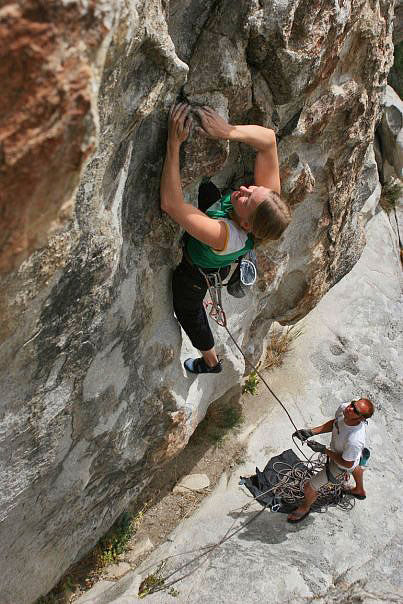 There’s an unspoken tension in the climbing world, lurking just below the surface. Sometimes it explodes forth in a string of vociferous comments, usually in an online forum, but much of the time it sits, slowly smoldering in the back of our collective minds. Trad versus sport climbing.
Specifically, there’s a faction of trad climbers out there who generally look down on sport climbers, since they “only clip bolts,” and some sport climbers are pretty sure every trad climber hates bolts and wants them eradicated from the face of the earth. In an effort to spread love and peace throughout the climbing community, we offer up the first in a two part series, this one designed to help trad climbers better understand their skinny legged brethren by dispelling some common sport climbing misconceptions.
Clipping Bolts Isn’t Scary
In theory, yes, but socialism also works, in theory. Just because you aren’t placing your own gear doesn’t mean there aren’t mental challenges. As a reformed trad climber, I can say that when I first embraced sport climbing, it was a little unnerving that I couldn’t put pro when I wanted it. I had to actually climb to that next bolt, whether it was six feet away or twelve. On most crack climbs, you can put in as much gear as you can carry, which really isn’t scary at all. Places like the Gunks or Eldo are of course a different story, and you have to climb a bit in between gear placements…just like in sport climbing…. In fact, much of pushing yourself hard in sport climbing is overcoming the mental challenges, making your body do the moves, even when they feel insecure and you might whip. And let’s not forget that anyone can place a bolt, so while it might seem more dangerous to trust gear you’ve placed yourself, it actually might be safer than that small piece of metal that some guy put in twenty years ago after finding some magic mushrooms in the forest and hanging from a rope all day.
Sport Climbing is Neither
This is simply untrue on every level, logically, metaphorically, spiritually, etc. Sport climbing is a casual way to have fun on the cliffs. Much like surfing, there’s beauty in the simplicity. No excessive gear, no route finding issues, no worries about weather catching you with your pants down. Heck, sometimes we don’t even have to clip our own quickdraws (bonus!). Just roll to the cliff, and bust out some pitches. It can also be a very athletic endeavor, and feels more like a good workout in the gym. It really will get you stronger, as you push yourself to your personal limits, and you can then take these skills to other climbing disciplines. (Trad climbing feels comparatively easier when you get a bunch of no hands rests in between the hard bits!) This appeals more to some than others, but there’s no question that sport climbing, especially when pushing your limits, requires a high level of athleticism. So in fact, sport climbing is in many ways a very pure expression of the sport of climbing.
Sport Climbers Don’t Have Technical Skills
Au contraire, my heavy rack carrying friend. While a fresh-from-the-gym neophyte might not really know much besides how to properly thread the GRI GRI and clip the lowering ‘biners, anyone who’s been in the game a couple years usually has a bag full of tricks not required in the trad game. Stick clipping (aka aid climbing) up a route to work out the moves, pulling the rope through mid-route to re-lead from a certain point, rodeo clipping, boinking, these are all advance rope tricks in the sport climber’s arsenal. I’ve never had to do any of that stuff on a trad route, so maybe they know more than you think.
Bottom line, sport climbing is fun, and that’s why people do it. There’s nothing like hanging out at a cliff with a bunch of your friends, taking in the beauty of the outdoors, pushing each other to break through physical and mental barriers.
Look for part two next week, where we uncover the bizarre world of trad climbing to those whose idea of a heavy rack is carrying fifteen of your own draws.

17 Responses to The Trad Climber’s Guide to Sport Climbing


Bulldog Creek Dog Walk (IV WI 4+)
Hayden Carpenter and Tom Bohanon recently repeated an obscure ice climb on the south side of Mt Sopris. Given a brief mention in Jack Robert’s ice guide, Bulldog Creek Walk is described as being 100 meters of WI 4. What they found was seven pitches of ice in a remote setting that makes for one […]
Connect with Us


Pingback: Link To “The Trad Climber’s Guide To Sport Climbing” « Peter Brown Hoffmeister
Pingback: The Sport Climbers’ Guide to Trad Climbing | Splitter Choss